


Commercial -
Rare Ahuriri landholding hits the market
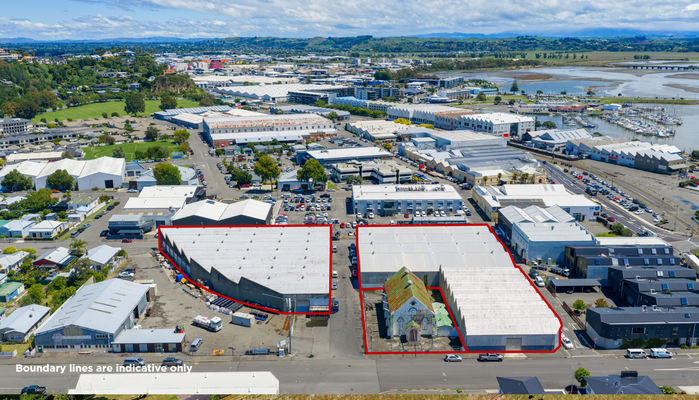
A rare large-scale landholding in one of Napier’s most tightly held coastal precincts is on the market for the first time in 33 years, offering owner-occupiers, add-value investors, and developers a chance to secure a strategic foothold in an area undergoing significant revitalisation.
Comprising four freehold titles totalling approximately 6,708sqm, together with around 6,070sqm of existing improvements, this portfolio offers a unique opportunity to acquire significant scale in Ahuriri where developable land is now extremely limited and hotly contested.
The buildings include former 1930s woolstores originally owned by shipping companies and one of Napier’s first churches, which was relocated from Napier Hill in the early 20th century.
The Mixed-Use zoned properties at 2 Mahia Street, 2 Tu Atu Street, and 26 Coronation Street, Ahuriri sit within the Iron Pot Historic Heritage Precinct and offer flexibility for redevelopment, repurposing, or staged intensification.
The heritage overlay highlights the area's significant social, physical, and aesthetic value, where the mix of commercial, maritime, industrial, and residential activity reflects Ahuriri’s rich history of reclamation and coastal development. This unique character environment enhances the long‑term appeal and distinctiveness of any future project within the precinct.
The property at 2 Mahia Street consists of around 3,030sqm of functional saw-tooth roofed warehousing on a 3,040sqm site, while 2 Tu Atu Street offers 2,650sqm of secure former woolstore warehousing, also with a saw-tooth profile, across 2,656sqm of land.
The wild card in the portfolio is 26 Coronation Street, a 390sqm former church situated on a 1,012sqm freehold site. Originally constructed on Shakespeare Road in 1859 for the Catholic Church, St Mary’s was dismantled and transported by bullock train to its current Ahuriri location around 1910. The church was decommissioned in the 1970s and sold, before later operating as The Church of the Southern Cross recording studios during the mid to late 1980s.
The Ahuriri properties are for sale by tender with vacant possession, closing on 5 March, and will not be sold prior. Purchasers can tender for individual sites, a combination of properties, or the complete large-scale portfolio through Bayleys Hawke’s Bay brokers Kerry Geange and Grant Anderson.
The combination of flat land, multiple road frontages, and existing buildings enhances development feasibility and will allow purchasers to implement value-add strategies while planning longer-term development initiatives, says Geange.
“The location is a major drawcard, positioned near the heart of Ahuriri Village and surrounded by high quality lifestyle amenities, including the picturesque inner harbour waterfront area and established café and retail precincts.
“This setting strongly supports high value mixed use development and adaptive reuse, with several former industrial buildings in Ahuriri already transformed into successful hospitality, commercial, and residential spaces.
“Council has invested heavily in improving walkways and cycleways around Ahuriri and it is a destination precinct for both locals and visitors to the region given its harbourside charm.
“Excellent connectivity to Napier Port, Hawke’s Bay Airport, and key arterial routes enhances the versatility of these assets, making them highly attractive to both investors and owner-occupiers.”
There has been strong interest in the properties since featuring in Bayleys’ latest Total Property publication. Geange says prospective buyers have come out of the woodwork for the former church, with many expressing a desire to relocate it elsewhere for refurbishment.
“Naturally, we urge parties interested in any of the existing buildings to explore what is allowable via council channels.
“Napier City Council is currently in the process of developing a new District Plan and in the interim, there is a proposed District Plan, and an operative District Plan. Both plans should be considered by potential purchasers in respect of any proposed use or development.”
Contact us


