


Commercial -
Developers Eye Former Bus Depot Site
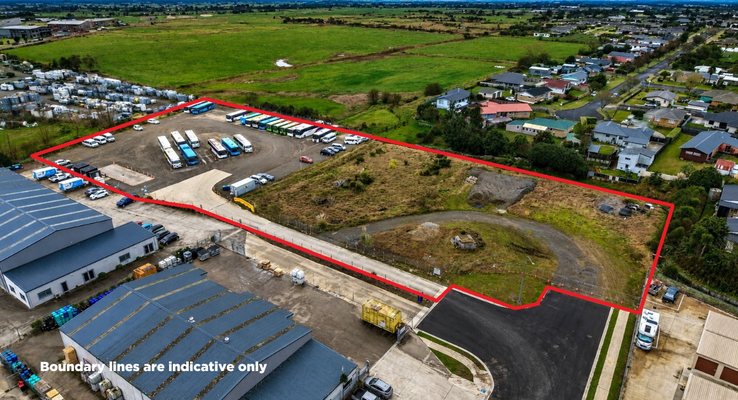
The undeveloped flat land sustaining a regional parking depot for New Zealand’s biggest bus company been placed on the market for sale.
The property in the Waikato township of Te Awamutu features an expansive block utilised by prominent national public transport firm Go Bus. The address sits in in the heart of Te Awamutu’s compact industrial precinct – with neighbouring properties consisting of several automotive repair and maintenance workshops, various farm product retailing depots, animal husbandry companies, and civil works yards.
Tracing its original roots back to the Waikato in the 1930s, sole tenant at the Te Awamutu site Go Bus is New Zealand’s largest passenger vehicle transport operator – with a fleet of more than 2,000 vehicles operating across New Zealand. The company and its distinctive red, white, and green branded buses provide school, charter, aged care, urban, and event transport services from locations spreading from Auckland down to Invercargill. Go Bus is owned by Australian-based parent company Kinetic.
The Te Awamutu Go Bus parking depot has a network of sister provincial locations in the likes of Tauranga, Gisborne, Napier, Whanganui, Nelson, Blenheim, Queenstown, Alexandra, and Dunedin. Underpinned by its national scale and reach, Go Bus has multiple long-term contracts with local councils and the Ministry of Education.
Go Bus utilises the flat gravelled yard at 301 Bruce Berquist Drive in Te Awamutu for parking its modern bus fleet, and is where bus drivers park their personal vehicles while out on their various routes in the district. The lease to Go Bus generates annual rental income of $106,000 plus GST and outgoings,
Now the 1.2387-hectares of flat undeveloped freehold land at 301 Bruce Berquist Drive in Te Awamutu is being marketed for sale by tender through Bayleys Hamilton, with tenders closing on September 9. Salesperson Josh Smith said the greenfield site was a scalable blank canvas opportunity for property developers to capitalise on.
The address at 301 Bruce Berquist Drive sits in the heart of Te Awamutu’s compact industrial precinct – a wedge of warehousing and factory properties sitting between State Highway 3 and Te Rahu Road, with Bond Road running through the centre.
“Zoned as industrial land under the Waipa District Council plan, the address could be developed and repurposed into any number of permutations subject to appropriate council consent – ranging from the straightforward construction of a multi-build terraced tilt-slab tradie style hub, through to the construction of a substantial warehousing building for the likes of a logistics or freight forwarding firm,” Smith said.
“Te Awamutu’s clearly defined industrial precinct is populated by multiple engineering and manufacturing factories and warehouses, along with numerous heavy vehicle yards. There is however a shortage of smaller, more niche tradie premises of say up to 180 square metres which are sought after by independent builders, plumbers, electricians, or communications and technology installation contractors with a fleet of just one or two staff on the road and an office manager/receptionist.
“This type of multi-unit tilt-slab premises in a concentrated hub format has become the ‘norm’ over the past 15-years in most New Zealand provincial and rural centres – either being built in greenfield locations as towns and cities expand, or replacing old and dated inefficient buildings and compounds as buildings on those sites come to the end of their useful life.
"The ongoing ground lease with Go Bus provides a steady annual holding income, allowing any new owner to explore development options and configurations. Of course, the property could be kept in its existing very much hands-off configuration to generate regular cash flow," Smith said.
Located some 30-kilometres south of Hamilton directly on State Highway 3, Te Awamutu has a population of approximately 12,000 residents. Smith said the town’s location and easy access to main highway routes stretching across the Waikato meant the Bruce Berquist Drive site offered a highly cost-effective opportunity for constructing new industrial premises.
“Te Awamutu – like Cambridge and Morrinsville elsewhere in the Waikato region – is increasingly being seen by Hamilton and Waikato-centric firms, as a more cost-effective provincial location in which to be operating from compared to suburban Hamilton zones with their higher land costs and greater traffic congestion,” Smith said.
Contact us


